Tee Shot Target Selection
I recently played a round with a caddy. I typically prefer playing without one, but on occasion, having someone with intricate knowledge of the course can really help out with target selection and overall confidence. My most recent experience with one was enlightening in many ways. I was playing well and his advice was paying off. On the 13th hole, I hit a tee shot directly at the target he gave me. As it was in the air, he said it was too far left and might be in the rough. Needless to say, I was befuddled and recalled a few other instances earlier in the round where he mentioned the same thing. This led me to clarify what I meant by target.
Define your targets by where you want the ball to land, not where you want the ball to start
I told him, my process gets me to where I want the ball to land, regardless of how it gets there. I typically play a fade off the tee so naturally, it will start left of where my eyes envision it landing. By doing this, I am letting the athlete in me react to where I want the ball to go. If you viewed every shot you hit where it landed from above, it would look like a shotgun blast. In picking my landing target, all I am trying to accomplish is getting the most amount of shots to end up on the fairway or green. Or better yet, where I can hit it again, unencumbered.
You can be a very good golfer hitting a 20 yard “slice” off the tee. You’d be surprised to see a lot of tour players who do this, especially when they need to get it in play. A lot of amateur golfers think like my caddy did. Their aim is where they want the ball to start. It’s helpful for feet and body alignment perhaps, but most pros can’t reliably hit the same shot over and over. How many times do you hear amateurs say, “if I am left, my slice will be perfect” and hit it dead straight? That’s your brain telling you something – your body react to the brains last thought.
Digging Deeper with Data
Scott Fawcett and many others have run the math on dispersion patterns. You don’t need to do that for your own game and in fact, using PGA tour benchmarks works better. Each shot you hit will end up somewhere on your dispersion chart. This looks like a cone if you overlay each club.
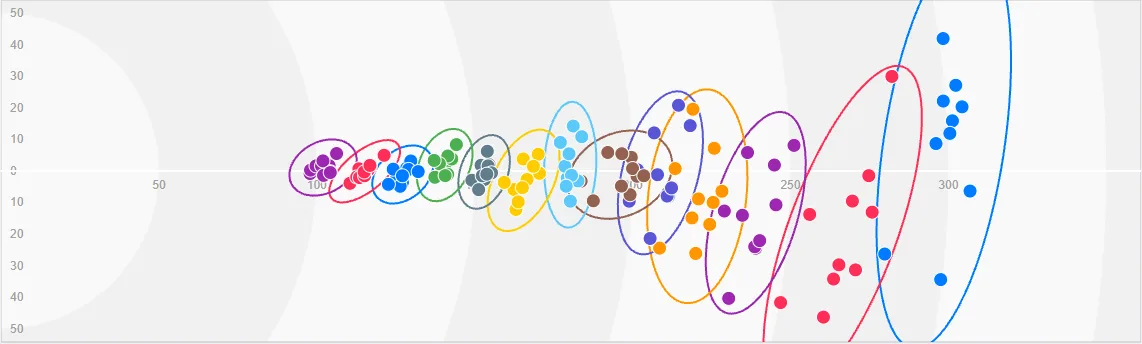
This is an example of my shot pattern via Trackman. Each circle contains 10 shots hit with every club in my bag.
As you can tell from my own data, the longer the distance, the wider the dispersion. With my natural fade bias as well, the longer clubs shifted further right of center. My driver group here also runs wider than the 60 yard tour benchmark below, but the benchmark is still the number I plan around. Fawcett via his Decade program assigns a dispersion distance to tee shots based on carry. This is validated by Richie Hunt’s work in the Pro Golf Synopsis. At 300 yards of carry, you need 60 yards in between penalty areas/hazards. That number is derived from any shot that is two standard deviations away from center. Said simpler, 95.4% of all tee shots will end up within 60 yards of each other from left to right. The shorter you hit it, the smaller the dispersion between left and right becomes. A good rule of thumb is about one fifth of your carry, so a 230 yard carry needs about 46 yards left to right.
This is physics. The more loft on a club, the harder it is to impart the spin that directs it further offline. You can find more videos (like this one and this one) online explaining why.
Armed with this knowledge, you then work backwards to selecting your landing point. The goal off the tee is simple: be able to hit the ball again. Notice I did not say the goal is to find the fairway. The easiest way to shoot lower scores it to eliminate balls in the woods, out-of-bounds, in the water or somewhere else unplayable. Typically, the decision tree looks like this:
- Is there enough room between unplayable situations that I can hit driver?
- If not, what is the most amount of club I can hit to avoid unplayable situations?
- If the answer is a 5i or less, you probably should still hit Driver. The distance you give up is worth more than the accuracy you gain. Note: this applies more to standard length Par 4s and 5s. Short par 4s designed to induce a lay up are usually exempt. Once your approach is inside 100-120, the distance has less of an effect.
- Find the center point of my dispersion between unplayable situations – that’s my landing target and acknowledge that it may be in the rough.
Data in Practice
Hole 12 at Wedgewood Pines is a good test of this decision tree. The hole was short, 360 yards from the tips and potentially driveable from forward tees. The hole featured a pond all down the left side up until about 30-40 yards from the green. The fairway also slanted towards the water and was about 30 yards wide the entire length. To the right of the fairway were a few trees protecting the 13th tee box but none that would require a re-tee or truly unplayable situation. I had more than 60 yards of room between unplayable situations (none to my right, water left) so there was no incentive to hit less club and lower my dispersion zone. The target that left me 30 yards of room left and 30 yards of room right happened to be down the cart path line/tree line. My target on each tee shot here, surprisingly, was that cart path line, right at the edge of the trees.
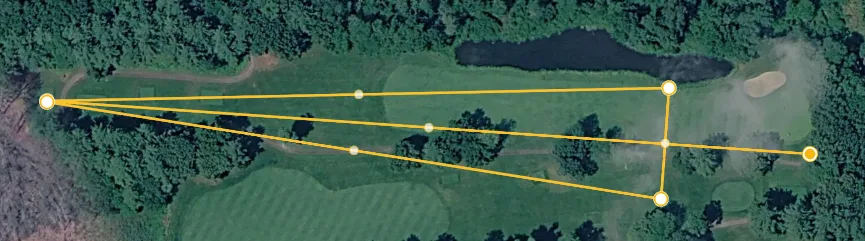
The 12th hole at Wedgewood Pines, overlaid with my shot pattern at 300 yards and 60 yards of left to right dispersion. The middle of that lands on the cart path and tree line.
You’re probably thinking, “this makes zero sense, he just said the goal is to avoid the trees off the tee. Why would you aim right at them?”
You are not wrong though let’s use numbers to quantify this. The scoring average of a 360 yard hole is 3.92 for PGA Tour players. They make birdie 8% of the time on a hole like this. From 60 yards out, it takes tour pros between 2.7 (fairway) and 2.9 (rough) shots to hole out. What that tells me is hitting a tee ball on this hole in the fairway gains me 0.22 shots against average (3.92 − 2.70 − 1, the 1 being the shot itself) and a shot in the rough still gains me 0.02 strokes. If I hit the ball in the water, I immediately lose a full stroke and I am hitting my 3rd shot from likely a farther distance than my 2nd shot could be from the rough. Let’s pretend I rolled into the water and was lucky enough to drop in the fairway for my 3rd shot. The tee shot would still cost me 0.78 strokes (3.92 − 2.70 − 2 = −0.78, the 2 representing the tee shot plus the penalty stroke). If I hit my tee shot into the trees and can only punch out to the fairway, 40 yards from the hole, the tee shot plus the punch out works out to 3.92 − 2.60 − 2 = −0.68 (two shots taken, 2.60 still to go). That is still about a tenth of a stroke better than the water (−0.78). “Sure, but you barely saved anything by punching out!” That is correct. What you aren’t factoring in is what I like to call the positive index.
Reframing the Brain
The positive index is something that all golfers should strive to apply to their mental games. Just because something bad could happen, doesn’t mean it will happen. Think about what can go right, not what can go wrong. On this particular tee shot, I might end up on the left side of my shot pattern and see a ball bounding down the fairway to 20 yards away from the green. It also might end up on the right side of my shot pattern and leave me an approach from the rough 80 yards out with no trees in the way. Hitting the ball in the water will result in a penalty stroke 100% of the time so it would behoove me to make sure my landing zone eliminates that entirely. Hitting the ball towards a cart path would result in at most a 5% chance of ending up in a truly unplayable, chip out sideways spot.
Richie Hunt defines this in numbers. The 60 yard dispersion example encapsulates two standard deviations worth of shots. One standard deviation captures 68.3% of all shots. That means roughly 70% of all shots will end up within 15 yards of the target. 70% of the time is still pretty damn good odds and reframing that in your mind before teeing off can have a massive impact. On a fairway 30 yards wide and centered on your target, seven out of ten drives will find it, which is about ten fairways if you hit 14 drivers a round. At Wedgewood, the fairway sat in the left half of my shot pattern, so roughly half of my drives should find the fairway and roughly half the rough and trees on the right. Only about 2% should find the water, which puts about 95% of them somewhere playable. It’s a data backed way to say, “Think of where you want to hit it, not where you don’t want to hit it.” The brain will naturally gravitate towards whatever you say and ignore the “don’t.”
Take It to the Course
The next time you play, reframe your target selection on where you want the ball to land. Center your shot pattern between the unplayable situations. Before you tee off on every hole, identify the unplayable situations and how much room you have between them. If there is less than 50-60 yards – depending on how far you hit it – you may consider dropping back to a 3 wood or iron but the goal should be to hit driver on every hole you can. Once you have identified that target, your sole focus should be getting the ball to land there, regardless of how you do it. Remember the positive index, not all your shots will be bad and in fact, 70% of the time they’ll be pretty good. You’ll be surprised how much better you’ll hit it when your brain rewires your thinking to ending target rather than starting line.