U.S. Four-Ball Qualifier at GreatHorse
Disclaimer: These post round recaps will focus on key decisions and moments throughout the round, to reinforce practice or to ingrain new learnings.
My approach when I was playing my best golf was never to force anything. Each shot, not each hole or each round, requires its own set of expectations. Best ball formats, especially USGA Four-Ball, tempts you to get away from it. Birdies aren’t nice to haves, they are required. You can chase them, in theory, more freely thanks to a partner helping you out. You’ll usually hear that in the quotes from teams advancing or winning. Birdies are important and necessary, though patience to not make bogeys is arguably more so. Having a partner can free you up. Having a partner in his pocket adds more pressure.
My last tournament of the season was the USGA Four-Ball qualifier at GreatHorse in Hampden, MA. My partner, Mike, and I have come close to qualifying multiple times. GreatHorse arguably set up the best for our games. In my now three rounds at the new Western Mass championship course, I have not hit less than driver off any par 4 or 5. On a course that generally demands length, having it is a major advantage.
One thing you must be prepared for in tournament golf is the unexpected. The forecast called for heavy rain during most of our scheduled time on course. Though less than ideal, knowing so ahead of time makes the mental aspect much easier to prepare for. Embrace the suck is a term that gets used quite often during wet, rainy rounds. With 30 minutes to our tee time, we received notice that it would be delayed at least 30 minutes, then again and again before it ultimately turned into a 4-hour delay. 4.5 holes later, we were called in again for a 90-minute delay. In better weather, I would have been home (assuming no pending playoff) and picking up my boys from school.
The other unexpected weather was the wind. The forecast called for rain but winds under 10mph. The wind was not under 10mph. If I had to guess, it was blowing a steady 20mph and gusting up to 30 at time. Helping when playing with it, borderline impossible playing against it.
Round Summary
Through the fits and starts, Mike and I had it going early, making birdies on 1, 2, and 3, before Mike hit his approach on 5 to within 10’. The horn blew and 90 minutes later, his putt slipped by on the high side. Hole 8 and 9 proved to be our downfall. A poor layup by Mike on the incredibly long par five 8th left me alone to salvage at least a par. Unlucky or not, my approach from 113 I thought was going to suffice, only to see it spin 40+ yards off the green. After missing a makeable par putt, we climbed (in the literal sense) up to the 9th tee box and were greeted again by a stout headwind. I was the only person to hit the green though a poor three-putt left us at -1 making the turn. A birdie on 11 preceded another bogey on 12 before making one final birdie on the short par 4 16th. Five birdies against three bogeys won’t get you a special invitation to Erin Hills next spring.
What the Data Says
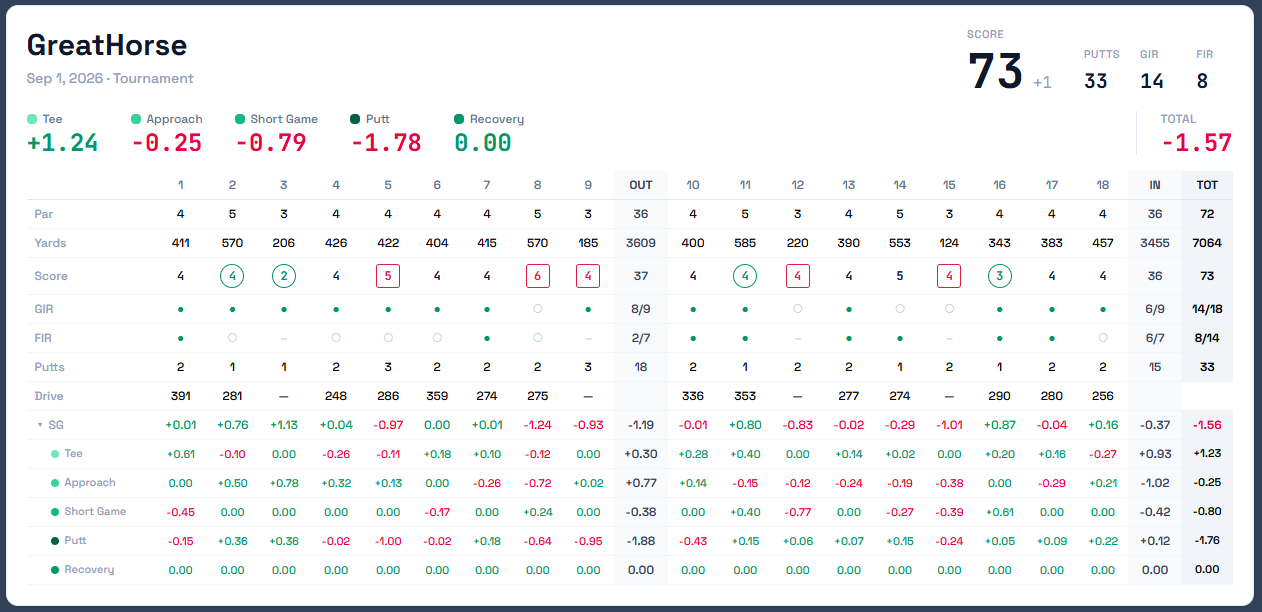 Click the scorecard for the full hole-by-hole breakdown.
GreatHorse always fits my game and eye. Expansive fairways and larger greens makes my Tee-to-Green stats pop, even if I felt as though I hit it ok. There were a few approach shots with unlucky breaks (hole 8 and 15) offset by a couple tee shots that made up most of the gains (hole 1, hole 10, hole 11) with distance. The driver was a touch shaky to start with some left misses but told myself that there was no reason to steer it left. After that, the only fairway I missed was 18. 14 greens is a number I love to see, though my proximity numbers were lacking, especially with wedges.
Putting continues to be a weak spot though I putted much better on the back 9 than the front 9 after switching back to the claw grip on 10. The three-putts on 5 and 9 hurt, 9 moreso and the par putt on 8 was non-competitive. The back 9 I had a three great lag putts on 13, 17, and 18 and made the putts I should have after lipping out birdie on 10. Chipping was really solid today and the only true leaks were hole 1 and hole 12 (more detail below).
Key Moments and Decisions
Hole 1, Shot 3
I had driven my ball all the way down the divisive 1st hole and was left with a soggy lie on an otherwise easy chip. Mike hitting his approach inside 4’ turned my brain from, “let’s chip it up tight” to “it’s ok if you don’t hit this one well.” You can guess the outcome after I made sure to hit too much ball to avoid the soggy turf. This was easily the worst chip of the day and lost me almost half a shot (-.45).
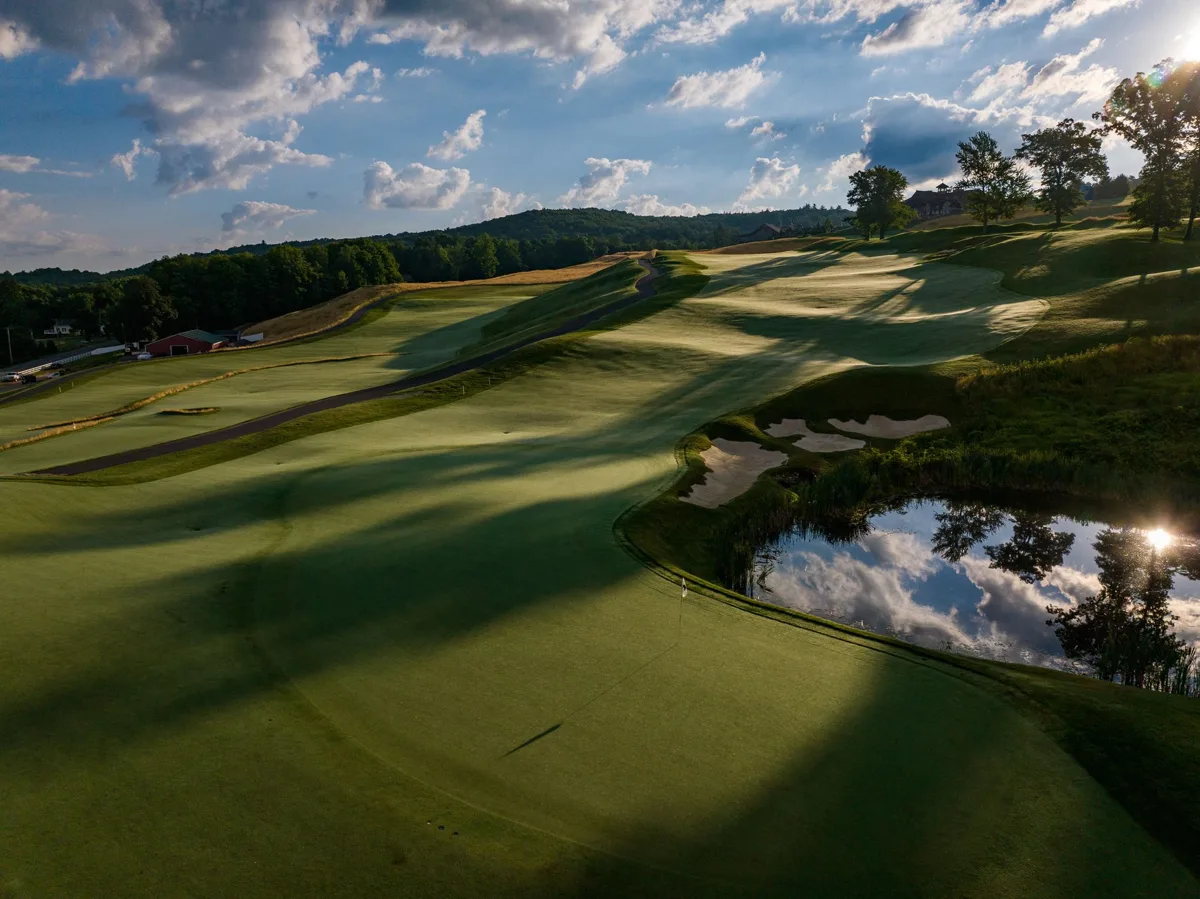 The par 4 first hole at GreatHorse. With the right bounce, drives end up in front of the green (image credit: GreatHorse)
Hole 2, Shot 1 & 2
Mike stepped up after the opening birdie and hit a tee shot that seemingly stayed in the air forever. My gameplan on the par 5 second was always to aim over the right side of the bunkers that cut in on the gentle dogleg. The carry over them is too much (~310 yards) but after watching Mike hit one that ultimately travelled 370 yards, I made a split-second decision over the ball to attempt the same line. Sure enough, that change of mindset resulted in a poorly struck shot into the left rough. Key learning here: never change your mind or decision over the ball. Step away and reset. If shot 1 was what not to do, shot 2 was what to do. I had 289 to the pin and with the wind direction, could have easily muscled a 5-wood near the green. The lie was bad enough that the risks outweighed the benefits so I reset, grabbed my 7 iron and punched one down the fairway. No need to compound a poor tee shot with a bad decision and the data says as much. I ended up gaining +.01 strokes after my first two shots.
Hole 3, Shot 1
Playing directly into the wind with a long iron, a lot of things could go wrong. Any mishit gets swallowed up and any push or pull goes further in that direction. This was about picking the correct shot to provide the highest probability of hitting the green. The pin was somewhat back left, 11 paces from the left on a large green. Decade principles say to take 5% of the distance and make sure your landing target is that far away from the edge of the green. Playing 206 though more like 230, that landing target was roughly 12 to 14 paces from the edges. I was anticipating playing a slight draw which turned my aim point further right to account for the wind turning it more than I expected and executed the shot perfectly, landing a 4 iron 6’ from the pin for birdie.
Hole 4, Shot 1 & 2
Hole 4 was playing directly into the same wind as hole 3. Off the tee, my aim point was quite literally in the left rough. Echoing what a headwind does to your ball, there was no need to hit a ball that had any chance of going in the water on the right. I might get lucky and it lands in the fairway but mentally, I was prepared to hit from the rough to avoid a full stroke penalty and the data agrees. I lost -.26 strokes with my tee shot, essentially gaining +.75 strokes by taking the water out of play entirely. Shot 2 was where, as I say sometimes, you just had to hit the shot. The peninsula green and reverse redan design meant hitting a shot that avoided the water short and long and letting the contours take the ball towards the back right pin. The lie wasn’t the best so my only option was to run it up the left side and hope the slope would take over. Though the result ended up fantastic, I feel like my process and decision could have been slightly better. I had 178 pin, 160 or so front edge and chose a 6 iron. I decided late in my process to punch it up the left side as my initial read was to hit it full at the left side of the green. Ultimately, I don’t think the initial read was incorrect, though if I committed to that, I should have hit 7 iron instead as 6 iron likely would have carried over the hill and into the water.
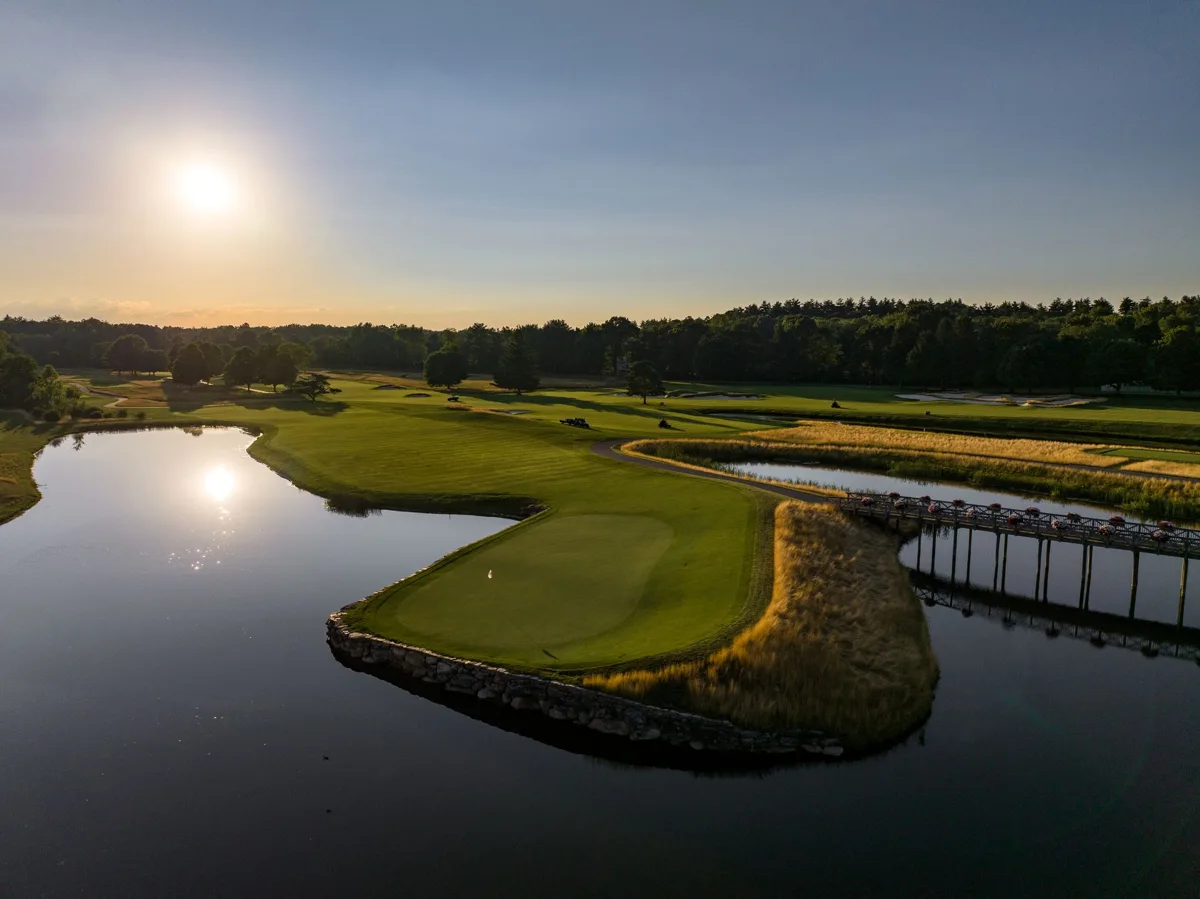 The fourth hole features a peninsula green with reverse redan features (image credit: GreatHorse)
Hole 5, Shot 2
Similar to hole 2, I pulled my tee shot left after attempting to get more distance out of the tee shot down wind. In the left rough, I had plenty of green to play with at my angle. The pin had 8 paces behind it from my view and 30 paces from my adjusted front edge. I had 136 playing downwind and in normal conditions, I would have likely hit Pitching Wedge about 90% to avoid short siding myself long. In this instance, I took gap wedge and hit it about 90% which admittedly was executed at 75% power. No bother, I found the green which is most important, even if the 40+ feet left led to a three-putt. The data bears this out as this approach shot gained me +.13 strokes.
Hole 9, Shot 1
Coming off a tough luck bogey on the par 5 eighth, avoiding another bogey by hitting the green on the redan styled 9th was paramount. I watched Mike and our two other playing competitors miss the green ahead of me. My thought process on this tee shot was simple. Aim at the high right part of the green and hit it solid. Similar to the 3rd hole where I knew the headwind would have a larger impact on the shot shape, my decision to aim further right proved very important as my 5 iron kept turning left before just carrying the cavernous bunker short left and trundling out to 30 feet. Though another three-putt followed, I hit the exact shot I had planned for and made the target adjustment to make sure even a gust of wind couldn’t prevent the ball from finding the surface.
Hole 12, Shot 1
After a birdie on the par 5 eleventh, the 12th provided one last downwind approach shot before turning back into the fan. The club choice and shot shape on this hole wasn’t incorrect, the target selection was. Playing 220 with the wind down and off the right, both Mike and I decided to hit 6 iron and let the wind turn it right to left. I can’t speak for Mike but I definitely was aiming farther right and did not take into account the right side left a screaming downhill chip running all the way to the back edge. We both ended up short-sided with impossible chips from tight lies. This is one instance where the strokes lost on the chip (-.77) really should be attributed to the tee shot (-.12). We both got caught up trying to make birdie, rather than making par and moving on. It’s crucial to understand where the easier up and down is as part of your pre shot routine.
Hole 14, Shot 2
I want to highlight this last one because hindsight, it was a very, very dumb choice. Playing into the wind, I hit a great tee shot and still had 290 yards to the final par 5 on the course. Waiting for my playing competitor to hit, I got this crazy idea to hit driver off the deck. 3-wood would likely bring into play the cross bunkers and anything less would leave a longer approach in. Needless to say, I hit a low shot that somehow scooted through the bunkers I was trying to avoid and settled in the rough. Walking up to my ball, I had not even realized how close it came to going in the water left. My mind waiting to hit was solely on the positive outcome and did not factor in the negatives. I should have at least hit 3-wood out to the right or punched a 4 iron up the fairway instead. I made par but it could have been much, much worse.
Final Thoughts
This is easily my best round of the year and bittersweet to happen on my last ‘real’ round. It’s been a dark summer from a golf perspective so finally getting back to my strengths of hitting the driver in play, hitting a lot of greens, and making a lot of pars was needed. There weren’t many bad decisions today and especially no catastrophic decisions. In the months prior, I would have likely let a bogey or two snowball into a bad stretch of golf. Today, there was none of that. Each shot and hole was a new opportunity and I never got down on myself. I hit all the shots and this post round debrief helped me realize how good mediocre shots are in the grand scheme.